
Almost everything written for Irish parents is about the Leaving Certificate, which leaves a large gap where the Junior Cycle should be. I run Study Skills Ireland and I work with first, second and third years constantly, and I would argue the Junior Cycle years matter more than most families give them credit for, just not for the reason people assume.
Does the Junior Cycle actually matter?
It matters, but not as a result. No college in Ireland asks for Junior Cycle grades and no employer will ever look at them. What the Junior Cycle decides is whether a student arrives into fifth year able to work independently, and that is worth considerably more than a page of distinctions.
So the honest answer to the student who asks whether third year counts is yes, though not in the way you think. The exam is a rehearsal. The habits are the thing being built.
I would be blunt with parents on this. A student who reaches fifth year unable to plan a week, take a usable note or revise without being supervised is starting the Leaving Certificate two years behind, and that gap is very hard to close in the middle of a points race.
What are classroom based assessments, in plain English?
Classroom based assessments are pieces of work completed during second and third year in each subject, assessed by the student’s own teachers against national descriptors rather than sent away to be marked. They feed into a written reflection and they appear on the Junior Cycle Profile of Achievement alongside the exam results.
The phrase parents need is that these are school assessed, which makes them different from the externally assessed components arriving into the new Leaving Certificate. Teachers meet to compare judgements so that standards line up across schools.
The practical significance for a family is that real marks are being earned during the year, on a deadline, away from the exam hall. That is the first time most Irish students meet that idea, and how they handle it tells you a lot about how they will handle fifth and sixth year.
Why do CBAs cause so much trouble at home?
Because they are the first deadlines a student has to manage themselves, and nobody has taught them how. A student who has only ever done homework due tomorrow has no method for a piece of work due in three weeks, so it sits untouched until the last two nights and then arrives half finished.
That is not laziness and it is not a character flaw. Managing a multi week task is a specific skill involving breaking the work into parts, putting those parts on dates and starting before you feel ready. Very few students pick it up by accident.
It is also the single most transferable thing in the Junior Cycle, because it is exactly what the redeveloped Leaving Certificate now asks for with its assessment components. A third year who learns to run a project is being trained for sixth year.

How should parents help with a classroom based assessment?
Help with the plan and stay out of the work. Sit down when the task is set, agree what the parts are and which evening each part happens, and then let the student produce it. A parent who rewrites their child’s project has taught them only that somebody else will eventually rescue it.
The useful question again is what is the next step, rather than is it finished. It keeps the work moving without turning you into an inspector.
If the deadline is genuinely about to be missed, the school would far rather hear from you early than see the work arrive late. Teachers are reasonable about this, particularly when something is going on at home.

What study habits should a Junior Cycle student build?
Three things. Writing down what is due and when, in one place. Working in short defined blocks with a finish time. And testing themselves rather than reading over notes. A student who leaves third year with those three habits will find fifth year an entirely different experience from their classmates.
The self testing one is where the biggest gains are and where nearly everybody goes wrong. Reading over notes feels productive and produces very little, because recognition is not the same as recall. Covering the page and trying to write it out is uncomfortable, which is precisely why it works.
None of this requires long hours at this age. Forty focused minutes on a school night, done properly, is worth more than a whole evening of drifting with a book open.
What about second year, the year everybody writes off?
Second year is where most of the ground is quietly lost. There is no exam at the end of it, motivation dips, and a student can slide for twelve months without anybody noticing until third year arrives and the gaps are everywhere. It is the cheapest year to fix and the most expensive to ignore.
The fix is small and boring. Keep the routine going, keep the note taking honest, and keep asking what is due. The point is not to pile on pressure at fourteen, it is to avoid the collapse in habits that then has to be rebuilt under pressure later.
I would rather see a second year with a modest routine they actually keep than a third year with an ambitious timetable they abandon in October.
How does this connect to the Leaving Certificate?
Directly, and more than it used to. The redeveloped Leaving Certificate now includes assessment components worth at least forty per cent of the marks, completed during the year and assessed externally. A student who learned to run a project during the Junior Cycle is walking into that prepared, and a student who did not is learning it while it counts.
That change makes the argument for taking second and third year seriously much stronger than it was five years ago. The Junior Cycle is no longer a dress rehearsal for one exam. It is training for the way senior cycle now works.
It is why we run study skills sessions for junior classes as well as for exam years. The habits are far easier to build at thirteen than to retrofit at seventeen.
Frequently Asked Questions
Does the Junior Cycle matter for college?
No Irish college asks for Junior Cycle results. What matters is that the years build the independent working habits a student needs in fifth and sixth year, which is where the real value sits.
What is a classroom based assessment?
A piece of work completed during second or third year in each subject, assessed by the student’s own teachers against national descriptors rather than externally marked, and recorded on the Junior Cycle Profile of Achievement.
How should parents help with CBAs?
Help with the plan and stay out of the work. Agree what the parts are and which evening each happens, then let the student produce it. Rewriting it for them teaches only that somebody else will rescue them.
How much should a Junior Cycle student study?
Around forty focused minutes on a school night, done properly, is more useful than a long drifting evening. The habits matter far more than the hours at this stage.
Why does second year matter?
Because there is no exam at the end of it, motivation dips and habits slide for twelve months without anyone noticing. It is the cheapest year to fix and the most expensive to ignore.
Building the habits before they are needed
Study Skills Ireland runs study skills seminars for junior and senior cycle students, along with talks for parents, in schools across Ireland. Enda O’Doherty delivers them personally, and the planning and self testing habits described here are what the junior sessions are built around.
You can see what the student study skills seminar covers, read about the parents seminar, or get in touch about bringing a session to your school.
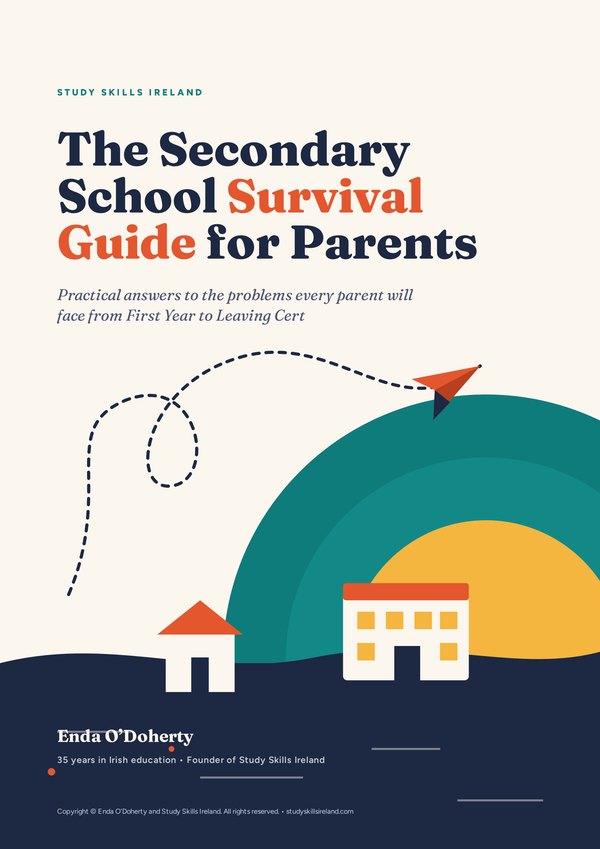 The Secondary School Survival Guide for ParentsFirst Year to the Leaving Cert and the CAO, with 26 printable worksheets included.€19, see the guideThe Big JumpA parent’s guide to First Year: settling in, homework, phones, sleep, study and the Junior Cycle.€19, see the guide
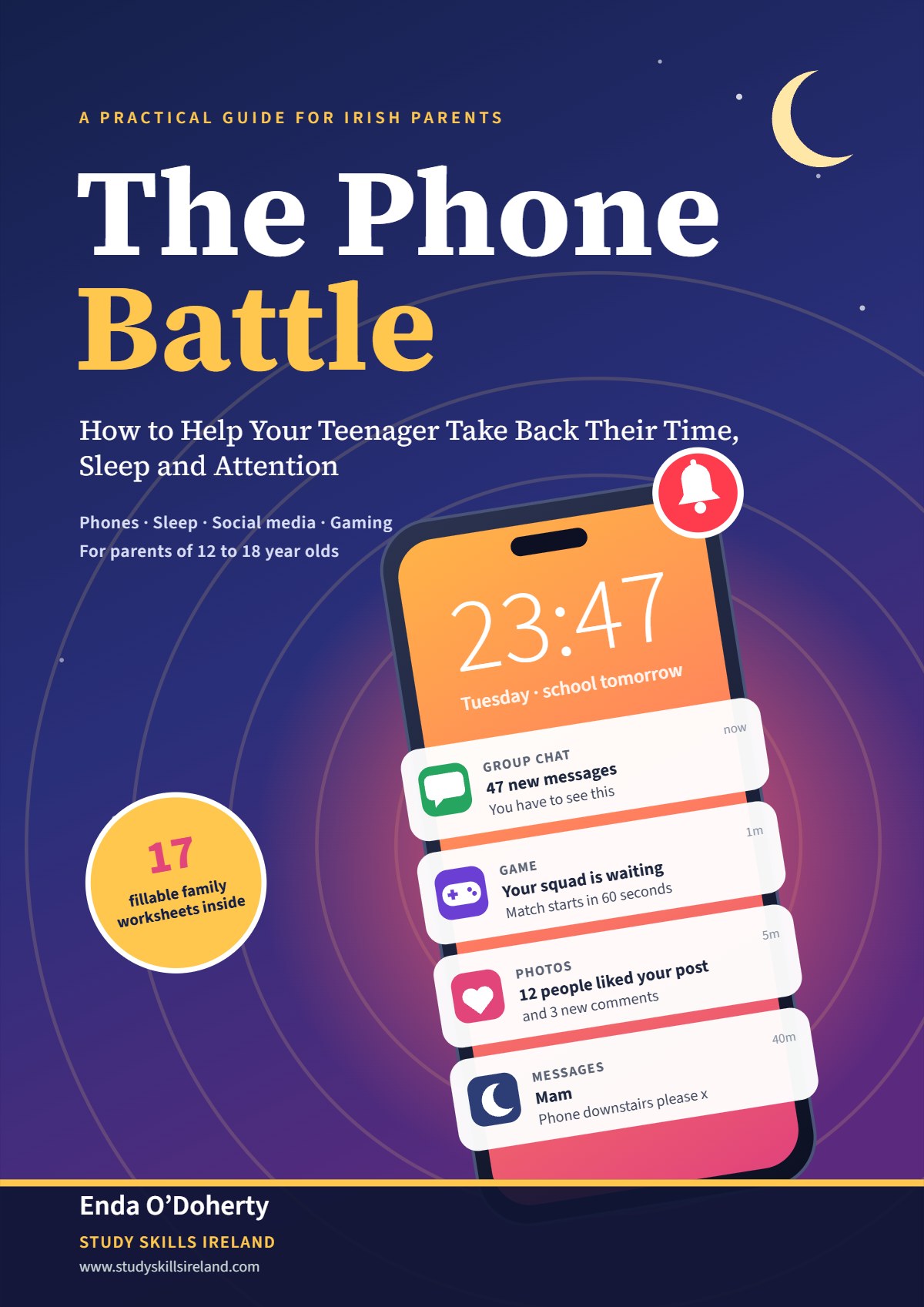 The Phone BattlePhones, sleep, social media and gaming. Experiments instead of arguments, with 17 fillable family worksheets.€19, see the guide